
Saxon Garden in Warsaw: Poland's first public park, baroque statues and the Marconi fountain
What to know: The Saxon Garden is a free, round-the-clock park behind Pilsudski Square: Poland's first public park (1727), with 21 baroque statues, a Marconi-designed fountain, a 19th-century sundial and about 1,200 trees, right next to the Tomb of the Unknown Soldier.
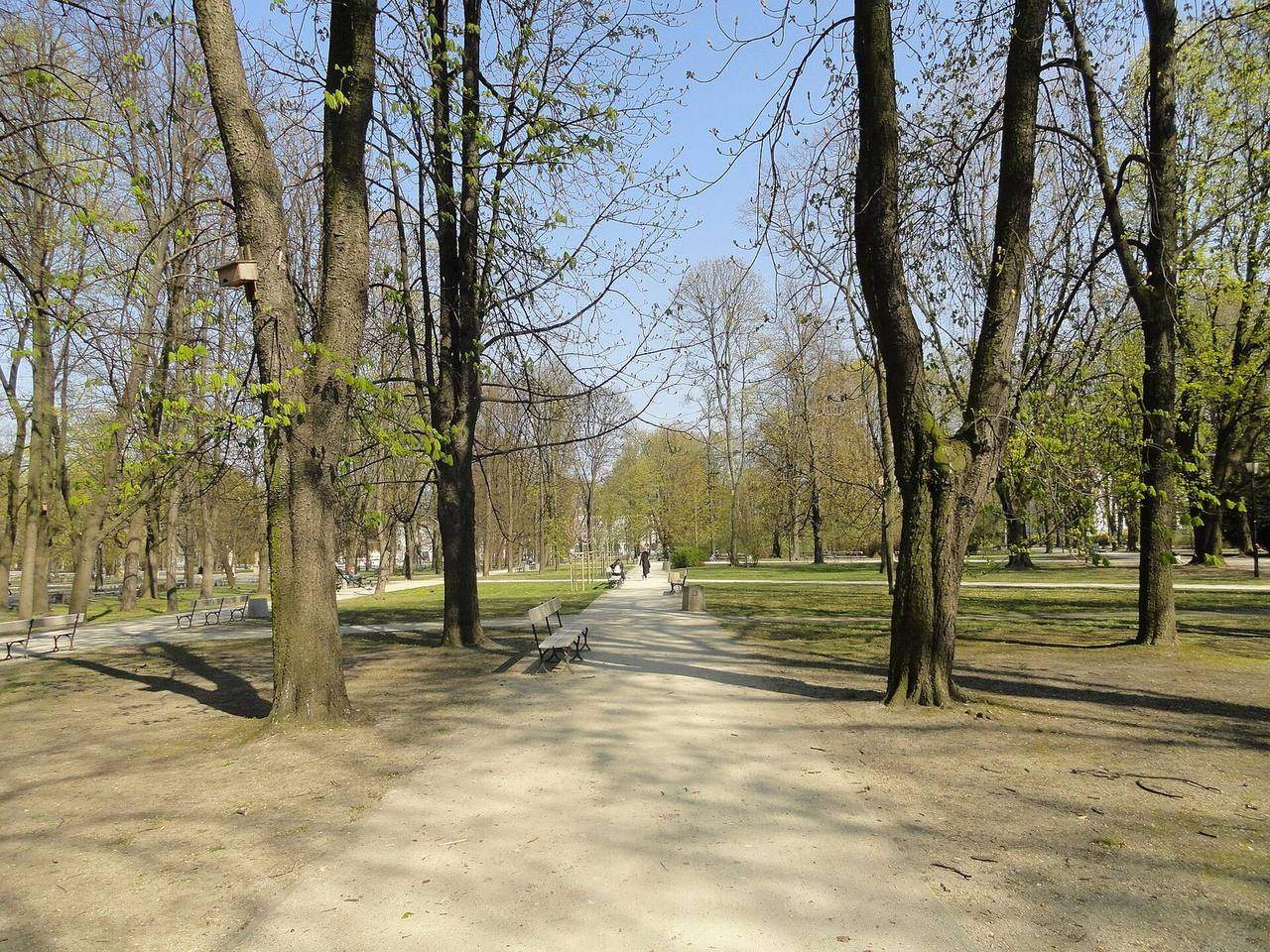
Photo: Cybularny, Wikimedia Commons (CC0). An alley in the Saxon Garden.
Few Warsaw parks carry as much history per hectare as the Saxon Garden (Ogrod Saski). Laid out as a private royal garden, it was opened to the public in 1727 - the first park in Poland made available to everyone. Today it covers roughly 14.6 hectares between Marszałkowska, Krolewska and Pilsudski Square, and entry is free at any hour.
Statues, a sundial and a boulder
The garden's signature is its set of 21 baroque sandstone statues of muses and virtues, made around the turn of the 18th and 19th centuries in the workshops of Jan Jerzy Plersch, Franciszek Ksawery Deybl, Jan Jerzy Donat and Jozef Vinache. They are the only original remnant of the Saxon Axis, the grand baroque layout of royal Warsaw. Near the fountain stands a marble sundial from 1863 that reads the time to within five minutes, and a boulder set up in 1927 marks the 200th anniversary of the garden's opening to the public.
The fountain that crowned Warsaw's first waterworks
The late-classicist fountain on the main axis is one of four water features built in 1852-1855 to celebrate Warsaw's first municipal water supply. Both it and the reservoir above the pond - a pressure tower disguised as the Temple of Vesta at Tivoli - were designed by the Italian architect Henryk Marconi. The system drew water from the Vistula and ran until 1886; since 1957 the reservoir building has served the Grand Theatre. Below it lies an oval pond of about 0.2 hectares with the Boy with a Swan sculpture by Theodor Erdmann Kalide.
Trees and nature monuments
Around 1,200 trees grow here, mostly small-leaved limes, horse chestnuts and Norway maples. Six trees hold nature-monument status, including four ginkgoes by the pond that turn a striking gold in autumn. Bird nesting boxes, an insect hotel and deliberately left dead wood support wildlife in the middle of the city.
Tomb of the Unknown Soldier and the palace rebuild
At the garden's eastern edge, on Pilsudski Square, soldiers keep an honour guard at the Tomb of the Unknown Soldier, housed in the surviving arcade fragment of the Saxon Palace. Under a 2021 act of parliament, the palace is being rebuilt: works started in 2022 and are due to run until 2030, after which the building is to host the Polish Senate, the voivodeship office and a cultural and artistic centre. The park's own paths were renovated in 2012-2014 with permeable surfaces.
Visiting
Enter from Pilsudski Square past the Tomb, from Krolewska or from the Marszałkowska side. The garden hosts concerts, the annual National Reading event and, since 2022, the Saxon Garden Festival, which recreates interwar Warsaw for a day. Combine a walk with the Royal Route, which starts a few minutes away at Castle Square.
FAQ
When did the Saxon Garden open to the public?
In 1727, making it the first public park in Poland.
Is the Saxon Garden free to enter?
Yes, admission is free and the park is open around the clock.
What is the fountain in the Saxon Garden?
A late-classicist fountain built in 1852-1855 as part of Warsaw's first city waterworks, designed by Henryk Marconi, with a reservoir building styled on the Temple of Vesta at Tivoli.
What is being rebuilt next to the Saxon Garden?
The Saxon Palace. Rebuilding began in 2022 under a 2021 act and is due to finish by 2030; the palace is to house the Senate, the voivodeship office and a cultural centre.
Sources
Follow Warsaw Daily on Instagram
Daily Warsaw news, events, concerts and city tips in English: @warsawdailynews
Related articles
The Royal Route in Warsaw: palaces, churches and gardens from Castle Square to Wilanow
Warsaw's Royal Route links the Royal Castle with Lazienki Park and Wilanow Palace along Krakowskie Przedmiescie, Nowy Swiat and Aleje Ujazdowskie. What to see along the way, from the official city guide.
Saska Kepa: pre-war villas, modernist streets and the geodetic centre of Warsaw
Saska Kepa is the right-bank neighbourhood of elegant pre-war villas and modernist architecture that kept a small-town feel next to the city centre. It even holds the official geodetic centre of Warsaw.
Warsaw Uprising Mound and the revitalized Burza Action Park in Mokotow
The Uprising Mound, heaped from the rubble of post-war Warsaw, crowns the Burza Action Park in Mokotow - fully revitalized and reopened on 31 July 2023 with a viewing platform, ravines and a nature path.